These pages show the effects of the large quantity of rainfall from Hurricane Jimena which struck the central Baja California peninsula in September 2009. The first photos were taken about 3 weeks post-hurricane (Sep 27-Oct 8, 2009). A follow-up set of photos was taken for a number of the same scenes about 7-9 weeks after Jimena (Nov 22-Dec 4, 2009). Look for differences in the two sets in terms of the amount of vegetation and color.
Click on any photo for a larger image
For more on Hurricane Jimena itself, visit these pages: Jimena links | Jimena Aftermath | Jimena's Legacy
Just a few photos from the northern range of the hurricane´s path, near El Volcán las Tres Vírgenes.
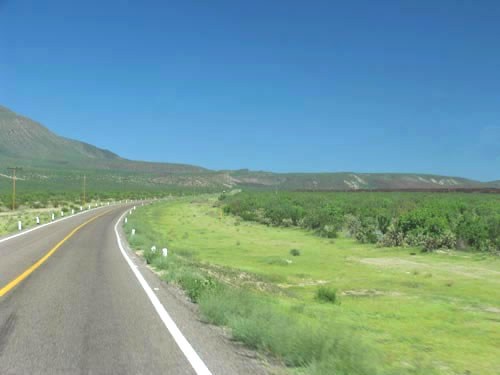
Road side with lots of annual grasses and beginning of perennials.

Not exactly the same scene, but very closeby. Nov 22. Jatropha cinerea and J. cuneata turning yellow.
The following set of photos were taken at the top of the final grade about a mile before the highway drops to the Gulf of California and into Santa Rosalía. The first row has a partial panorama from left to right. In Sep 2009, the hillsides in all directions were carpeted in yellow (mostly Pectis papposa) and green (small annual grasses like Bouteloua aristidoides and B. barbata). In December, the ground cover was all but dried up. The only obvious plant still in bloom was Allionia incarnata (Trailing windmills).
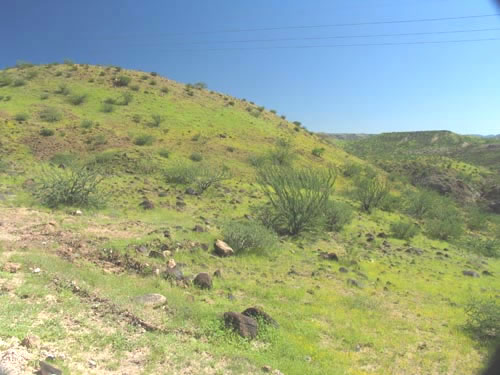
Sep 27

Dec 4
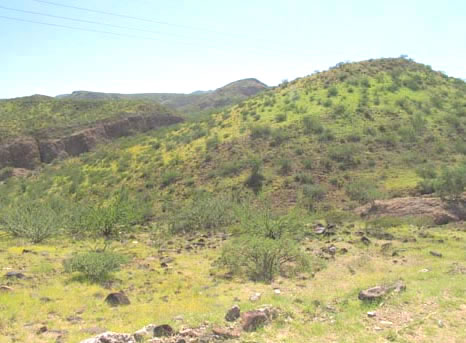
Sep 27

Dec 4
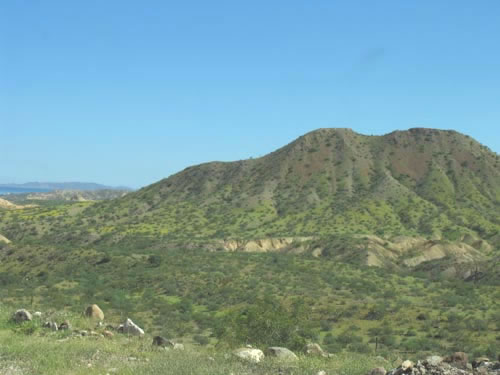
Sep 27

Dec 4
The following set of photos was taken just south of the Mulegé Pemex station in an extended dune field which is part of El Gallito point. In October, grasses (Cenchrus ciliare, Bouteloua barbata, B. aristidoides and Cenchrus palmeri) and Watson Amaranth (Amaranthus watsonii) tended to dominate. Other annual or perennial plants had sprouted and had some growth, but mostly had no flowers yet.
In late November, there was a large variety of plants in full bloom and many had well-developed fruit. Some of the species seen were: Tidestromia eliassoniana (Honeysweet), Euphorbia eriantha (Louse spurge), Euphorbia polycarpa (Sand spurge), Phaseolus filiformis (Slimjim pea), Trianthema portulacastrum (Horse purslane) and Proboscidea althaeifolia (Devil´s claw).
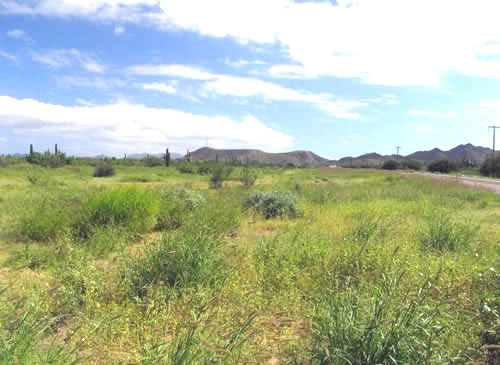
Field south of Mulegé Pemex, Oct 6.

Field south of Mulegé Pemex, Nov 28.
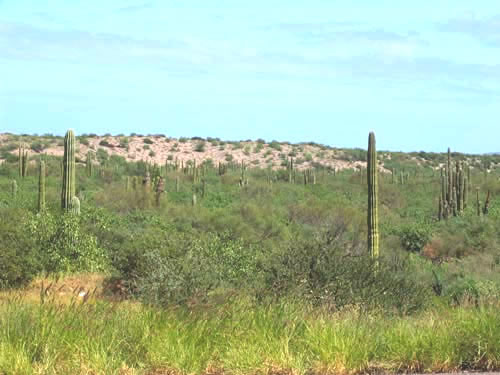
El Gallito dunes south of Mulegé Pemex, Oct. 6.

Not exactly the same shot (Nov 28) but very close to the same area. Note the forground colors as well as the mid-band of yellowing shrubs.
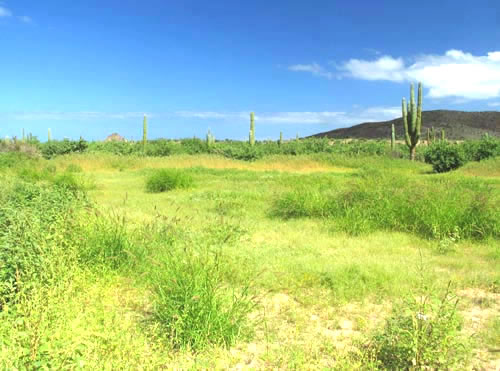
Field south of Mulegé Pemex, Oct. 6.

El Gallito dunes south of Mulegé Pemex, Nov. 28.
The following photos were taken in the Mulegé Valley, just out of town to about about 4 miles west of town.
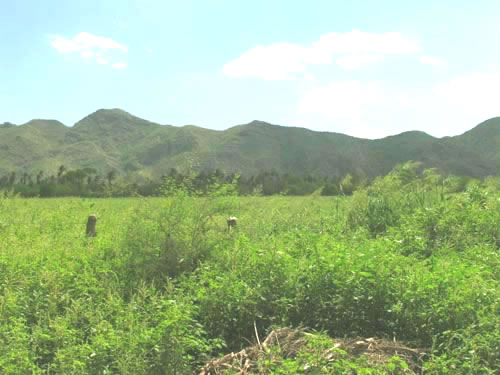
Agricultural fields in the Mulegé valley overtaken mainly by Amaranthus watsonii and Panicum antidotale. Oct 7.

Same fields Nov 29. A portion of the Amaranth has been cut down and livestock was grazing.

Same fields, Mulegé Nov 29
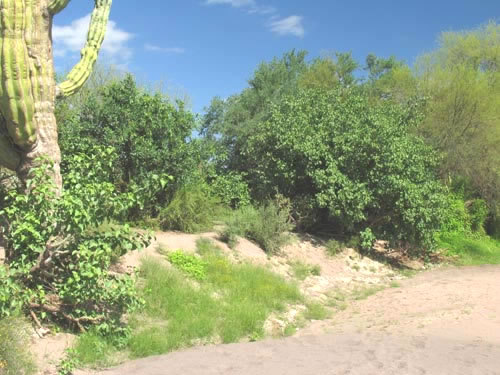
Arroyo bank in Mulegé valley, Oct 7

Same arroyo bank, Nov 29. Jatropha cinerea (Lomboy) already losing leaves and annual grasses dried up.

Brandegea bigelovii (Desert Starvine, Cucurbitaceae) in arroyo, Mulegé valley Oct 7.

Same plants on Nov 29.

Arroyo bed on Oct 7.

More or less the same view, Nov 29. Mainly note the dry grass on the other side of the arroyo.

Brandegea bigelovii and Echinopepon minimus (wild cucumber vines) along the arroyo bank, Oct 7.

Unlike most of the plants in the valley which were getting drier, the cucumber vines, as well as Coyote melons, (see below) were actually more lush and growing like mad.

Topiary figures in the valley, created by the wild cucumber vines, Nov 29.

More topiary figures.

More topiary figures. The red is Trianthema portulacastrum (Horse purslane) which is drying up.

Coyote melons (Cucurbita cordata) vines. These plants were seen in large numbers. The vines, coming out from under trees and shrubs and crossing the ground looked like giant tentacles. Made me think of the utterly silly movie "Attack of the Killer Tomatoes". Yikes, watch out or the coyote melons will get you!

I was walking along with my head down, the sun in my eyes, when I saw these cucumber vines in front of me, crossing on top of the short annual grass species Bouteloua aristidoides. I took the photo then moved forward and turned to try a different angle.
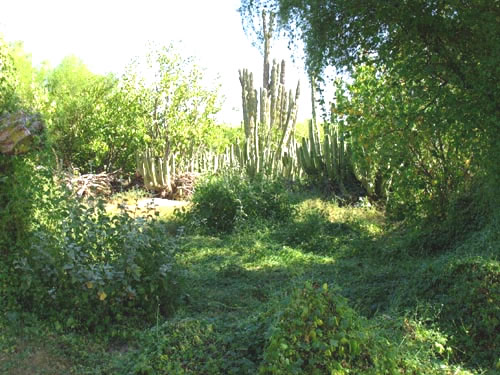
With the sun out of my eyes, I looked up and to the right and saw this incredible site, a cucumber vine grotto.

Annual grasses (Bouteloua aristidoides, Eragrostis cilianensis), Oct 2009

Same grasses in their pesky stage (when Bouteloua aristidoides earns its Spanish common name "Navajitas", or little knives). You´ll understand the name when you get them in your socks!
